This was the initial sketch for the painting. I was looking for a sense of rhythm in the design.
I did the sketch with ultramarine blue and transparent red oxide.
About Me
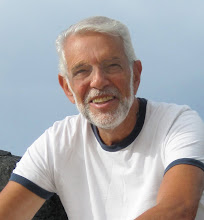
- Guy Corriero
- I was born and raised in Brooklyn, N.Y. My educational history is as follows: Long Beach High School, School of Visual Arts, C.W.Post College, M.A. in Humanities, Hofstra University. A two year stint in the U.S.Marine Corps as a illustrator eased my entrance into civilian life as a commercial artist in N.Y.C. My teaching career of twenty five years began at the State University in Farmingdale, N.Y. and ended as a Professor of Fine Arts at Herkimer County Community College, where I was awarded The New York State Chancellor's Award for Excellence in Teaching. I now paint full time in Portland Maine where I live with my wife Sharon. I paint all subjects from portraits to landscapes but I especially love painting the sea. Last year marked the end of forty straight years of teaching workshops on Monhegan Island, Maine, I now conduct three day classes in Kennebunkport every spring and fall. My work can be seen at The Wiscasset Bay Gallery, Wiscasset, Me., Dowling Walsh Gallery, Rockland, Me.,Camden Falls Gallery, Caamden, Me. and here in my studio in Portland. I am a signature member of The American Watercolor Society and the New York State Watercolor Society.
Friday, July 15, 2011
Step 2, Jewel's Falls
I tried to lay in the major masses of color and the darkest values first. The grays are combinations of cobalt blue, rose madder and yellow ochre. The dark water in the foreground were just about the same colors perhaps with a switch to raw sienna instead of yellow ochre in order to make the green darker.
Final Painting
Here's the painting just about complete. I added a few final touches with the brush but the painting remains a work mostly done with palette knife.
Wednesday, July 6, 2011
Approaching Storm In Mexico
We were out painting in the campo outside of San Miguel de Allende, Mexico. I was just about finishing a watercolor of a beautiful old church in the center of town when a dark cloud approached. It stared to rain so we headed back to the car. I did this painting from the back seat as the dark clouds were passing over. Sometimes misfortune turns out to be fortunate!
Western Wind
Published in this winter's American Artist Watercolor Edition this painting was the end result of a demonstration done in the magazine. The article showed the step by step procedures leading up to this final resolution.
Surf At Two Lights State Park, Cape Elizabeth, Maine
Like the painting below, this was also painted on illustration board and like the painting I had a few problems to solve. The high spray in the center was there without any rocks near it. I thought it was fine at first but then after looking at the painting a few months later I decided to add the distant rocks to give a reason for the additional foam shape in the center.
I'm still not sure about the "pinching" effect of the two rock forms meeting at the right center. I think I'll fix that too now that I mentioned it.
Surf Below White Head
I think it's obvious that the entire painting was done in the studio from my memories of Monhegan. There was, what I think, an awkward form in the breaking wave and I couldn't solve the problem so I put in some rocks (center) where the breaking water was giving me trouble.
Did anyone notice that?
Oh yes! Another note: The painting is on heavy rough 300 lb. Arches paper.
Did anyone notice that?
Oh yes! Another note: The painting is on heavy rough 300 lb. Arches paper.
Rising Tide At Lobster Cove
Once in a while I'll paint a watercolor on illustration board. Of course there are pros and cons to this technique.
One of the pros is the fact that you can lift the paint a bit, just a bit. The con side is you loose control of the paint more easily as it doesn't have the tooth of my usual 140 lb cold press paper.
I started with the sky and work forward, painting the dark rocks last designing them to move the eye back towards the breaking wave.
One of the pros is the fact that you can lift the paint a bit, just a bit. The con side is you loose control of the paint more easily as it doesn't have the tooth of my usual 140 lb cold press paper.
I started with the sky and work forward, painting the dark rocks last designing them to move the eye back towards the breaking wave.
Heavy Seas
I first had the idea for this watercolor when I first took the cliff walk at Prout's Neck most especially the from the sun shinning on these particular rocks.
The painting was done in the studio. The preliminary sketch in pencil came first then I worked from the sky forward. As you can see the sky set the color scheme for the entire painting.
The colors at low tide on Lobster Cove are just too juicy to pass by. My students had left the island the day before and I leisurely set up my easel and quickly painted this 18x24 watercolor.
Once again I had to capture the cast shadows on the beach quickly as the sun seems to move faster in the morning. (of course it doesn't) but the early morning light had to be captured fast. .
It had rained the day before and I just managed to get a feeling of wet ground the next day. I wish I started painting earlier as the puddles of water were more striking.
The light on the ground was extreme because they put down some straw to get the grass seed going.
Painting like this is always a challenge as the sun moves quickly and therefore changes the entire subject.
The subject is the Old Black Duck fish house on Monhegan Island, Maine.
The light on the ground was extreme because they put down some straw to get the grass seed going.
Painting like this is always a challenge as the sun moves quickly and therefore changes the entire subject.
The subject is the Old Black Duck fish house on Monhegan Island, Maine.
Friday, May 27, 2011
Another falls painting from Acadia. As in the other Acadia paintings all the stone and rocks were done with palette knife. The finer lines in the fallen tree were also done with the knife.
The colbalt blue touches in the foreground water are much more subtle in the painting but the digital camera pulls them out way beyond the desired effect. In any case, you get the idea.
This painting fought me all the way as I didn't think the foreground fallen trees and limbs were big enough in the composition, however after working on some of the detail in the dead trees and the light reflections on the right I began to become more confident in the outcome.
The palette knife came in handy in this painting as well. The reds behind the rock are not as red as they are in the photo.
Monday, April 11, 2011
Winter of 2011, Portland, Maine
It snowed just before we left for Mexico this February. The trees just outside my studio window were coated with heavy snow and the early morning light had just caught on the edge of the branches.
The painting was done in the studio after making several pencil sketches to get a good design of values.
It's a 16x20 oil on linen canvas board.
The painting was done in the studio after making several pencil sketches to get a good design of values.
It's a 16x20 oil on linen canvas board.
Once again the palette knife was used to do just about the entire painting including the dead wood on the trees.
I hiked a long way into Cathedral Woods on Monheagan unit I came to the base of Whitehead, the tallest cliff on Monhegan.
I tried, and I think sucessfully, to make a needed focal point at the base of the fallen tree.
The painting is a 16x20 oil on linen panel.
I hiked a long way into Cathedral Woods on Monheagan unit I came to the base of Whitehead, the tallest cliff on Monhegan.
I tried, and I think sucessfully, to make a needed focal point at the base of the fallen tree.
The painting is a 16x20 oil on linen panel.
Acadia Fall
Here the pallet knife came in very handy. About three quarters of the painting was done with a medium knife. The water in this JEPG photo is much bluer than in the actual painting as water, of course, will reflect all the colors around it.
Unless your shooting with slide film the color in digital only approximates the true colors unless you shooting in what is called RAW, which requires a very expensive photoshop program. In any case you get an idea of what the actual painting looks like.
Subscribe to:
Posts (Atom)


